
“To be ‘beautifully honest’…” – Creative Insights from India: Pradvay Sivashankar
Amphion’s first immersive audio installation in a private studio in India
On the Coromandel Coast, off the Bay of Bengal, is the city of Chennai – a major cultural, commercial, economic, and educational hub in Southern India. And recently, we were able to interview Pradvay Sivashankar, a multi-talented musician, engineer, and producer – deeply engaged in India’s massive music and film industry. Pradvay talked to us from his newly expanded private studio – taking us on a personal creative journey from his personal creative space. Working with many of India’s most lauded artists and producers, his words and actions exemplify the determination and dedication needed to engage successfully in this very competitive industry. And we’re proud he chose to include Amphion as a critical creative tool.
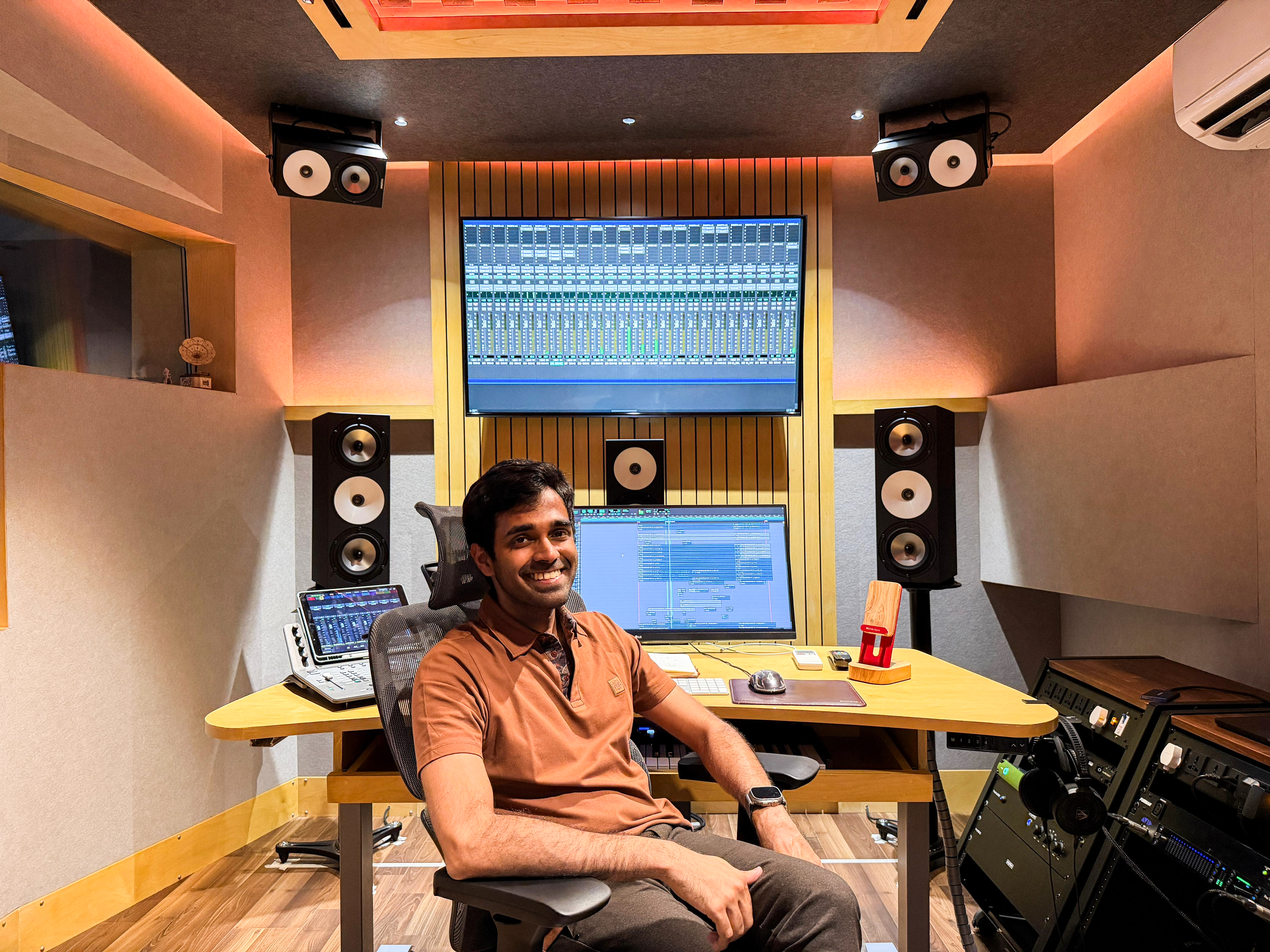
Q1. PRADVAY SIVASHANKAR BRIEF BIO: A musician, composer, producer, and engineer, where did you complete your studies, and what inspired you to enter the creative industries ? Has your study and work solely been in India? And where is your studio located? What would you rate as your primary instrument? Your voice?
I grew up in a multilingual household in Bangalore where everybody had a keen inclination towards music. On the one hand, my parents who really loved singing and had a deep appreciation for a wide variety of music like Indian classical, film music and old english songs, pushed me into formally learning music early on – particularly Hindustani classical Tabla. And on the other hand, my nerdy elder brother who loved progressive rock and metal kept exposing me to more intricate and calculative music that I feel greatly imparted intrigue and an analytical nature to my listening. Through my school years, I gradually picked up other percussion instruments and also learned how to play the keyboard on my own. My parents recognised much sooner than myself that music came more naturally to me than anything else, so they really supported and guided me into pursuing music as my main career path.
I moved to Chennai in 2011 and joined KM Music Conservatory (KMMC for short) which was founded by AR Rahman sir. I formally studied western classical music for three years with a focus on piano and composition, before transferring to Middlesex University, London, to complete my BA with honours in western classical music composition. During my college years, I simultaneously pursued a diploma at the School of Audio Engineering (SAE) (formerly in Chennai) to go deeper into the engineering and production aspect of music. I’d be lying if I said I had a primary instrument; I’ve enjoyed playing all percussion, keys and singing over the years but I’m more than a bit rusty now (lol). Chennai is home to my new setup!
Q2. MENTORS, NETWORKS, & PROJECTS: You’ve worked extensively with the iconic and nationally-revered composer, producer, musician and philanthropist AR Rahman, and a number of other prominent figures in India’s music/film industry. Could you share with us some of those experiences and/or memorable projects? In such a saturated creative-market, how did you penetrate it, and what approach do you recommend for young producers and composers to follow to gain entry and make a sustainable living in this field?
Yes, I’ve had the amazing good fortune of being associated with Rahman sir for over 10 years now, and it’s funny – it just doesn’t sink in. One of my oldest and most memorable experiences will always be accompanying him as a percussionist on his Coke Studio episode. To be in the very same space where music videos you grew up watching and admiring were made, and sharing it with very prominent musicians and technicians; It was something out of a fairy tale for a young student like myself. Another really memorable project for me was the movie 99 Songs for how in-depth I got to work on all the songs and background score for the first time, and to be responsible for the entire music post production process like never before; I picked up Pro Tools and surround mixing while working on that one project. Ponniyin Selvan will always be a special project for me for personal reasons, not to mention the immeasurable honour of working on the legendary Mani Ratnam sir’s magnum opus.
To young producers and composers, it can be completely natural to feel lost and not know where your niche is. One day, you might just stumble upon it and have that eureka moment! So, until then, broaden your horizon and skillset to learn and improve upon the other sides of music that may benefit you long term, be it learning an instrument(s), music production, post-production, the business side of things, etc., as you can do all of this while simultaneously honing your core skills as a musician or technician. The more you learn and grasp things deeply, the more self-assured you are in your skills, your self-respect and your worth. I never envisaged being a mixing and mastering engineer after returning from London. One year I was doing a fellowship with ROLI, working extensively with music production students to incorporate the revolutionary Seaboard into their existing curriculum in a way that pushes them to apply their technical knowledge in the real world; And the next year I was handling the post production of western classical music performances at KMMC, until one fine day something I worked on fell into Rahman sir’s radar, and the rest is history! Guidance has always been a key aspect of my journey. My family has always been among my main pillars of support. Working with Rahman sir and my colleagues has largely shaped me into who I am today. Dr Adam Greig, who is the academic coordinator at KMMC, has been an ever-present mentor and guiding figure in my life.
Coming back to the question about making a sustainable living in a saturated creative-market, there’s no easy or correct answers to this, only personal ones. The almost complete shift of music to streaming has made music more accessible but it’s also created a flood of demand and supply. Feeling the pressure to cater to this demand and focusing on standing out CAN put you at an artistic crossroads. I would go back to my point about finding your niche and striving for excellence within. Standing out and having an impact with your work can be a by-product rather than an end-goal. It would be amazing if artists could express themselves freely, because the feeling of being happy with your work is definitely sustainable on the long run. Needless to say, networking and being around like-minded people will be imperative to your growth.
Q3. BOLLYWOOD, TOLLYWOOD, KOLLYWOOD …: With these film-industry nicknames of Bollywood, Tollywood, Kollywood, and more that abound in India (and in a few other countries around the globe), help our readers understand the core differences. The film output of India is staggering, and dwarfs the Hollywood industry. Is it solely language-based variance, as India has 22 official languages, or is it broader than that ie. regional/cultural identity, traditional, musical? Do you work across the various production sectors? How challenging is it?
Oh, there’s a lot more than just those three! Fundamentally, you could say the key difference is language, but there’s definitely a lot of difference when it comes to the visual and sonic experiences that watchers and listeners of their respective regional industries have grown accustomed to. Without going into specifics, you might notice differences in the way editing, VFX, SFX and dialogues are presented; Music too – choice of instrumentation, structure and progression of songs, treatment of space and reverbs, overall loudness, function and usage of background score, and so much more! Of course, I do not mean to generalise. The variations I mentioned can easily be found within one regional industry itself, so it’s very situation and requirement dependent when it comes to films.
I do work across various production sectors, and yes it can be challenging initially, especially with song mix references. Often, mix references end up being songs that are most popular among the masses regionally, and just sometimes they might be completely outside of your sonic palette, and that could prove to be a challenge; Thankfully, the adjustments that need to be made to your own workflow and quality of output are rarely drastic. The key is to be consistent with the output throughout the project.
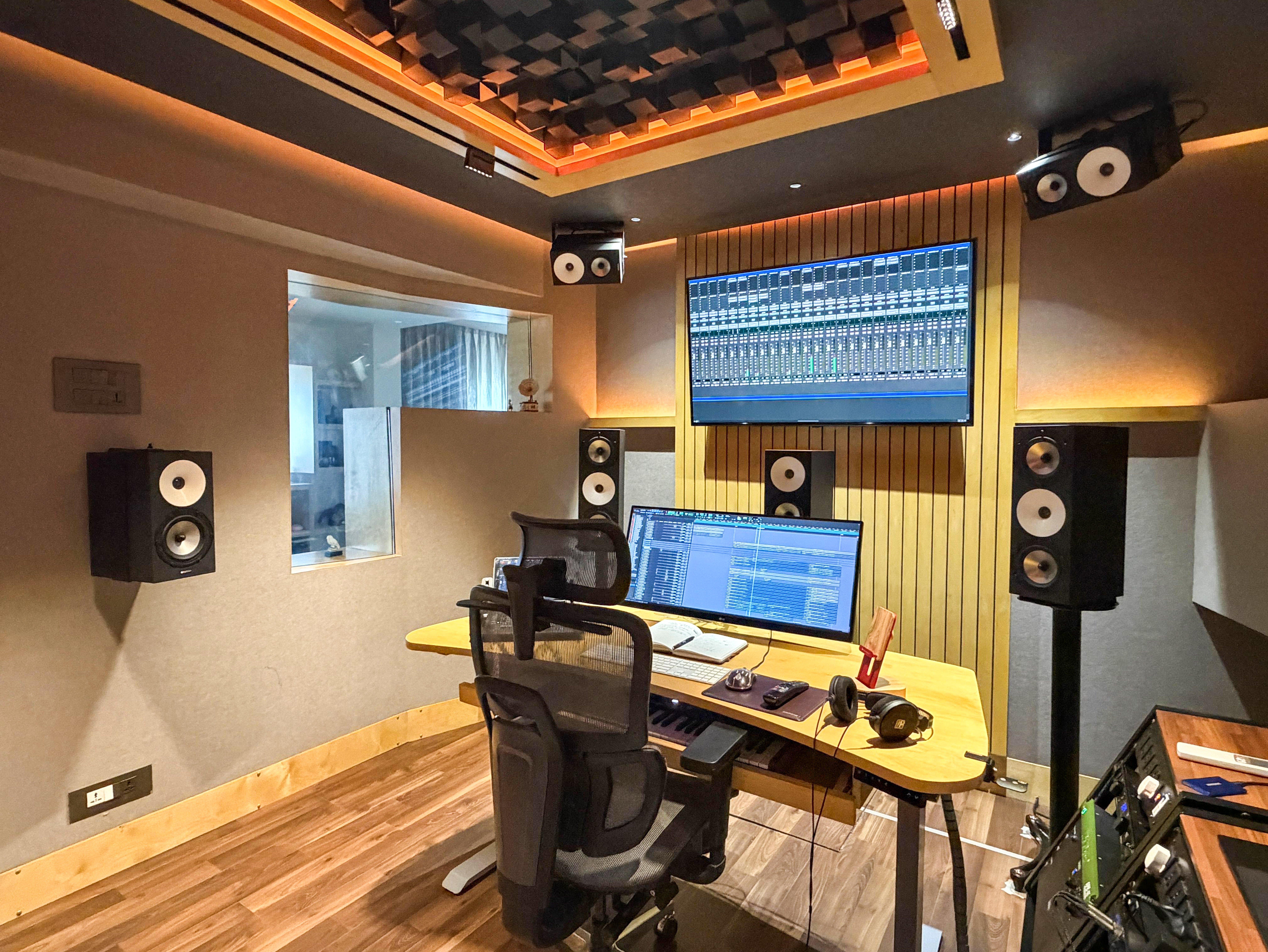
Q4. AMPHION 7.1.4 STUDIO: Tell us about your recent 7.1.4 studio expansion … What Amphion units do you have in your configuration, and what other rack-gear and systems drive your room? What made you decide on Amphion as your go-to monitor? And will this immersive audio format be the main focus of your work from now, or will you offer a broad range of sonic solutions from stereo, surround, to immersive?
I recently expanded my personal setup into a new space and 7.1.4 configuration. I bought the Amphion Two18s back in 2021 after a lot of research, and I instantly fell in love with them. Bearing in mind I’d been using them extensively in a bedroom with minimal treatment, they still sounded incredible. I found mixing and production so easy on them, pinpoint stereo imaging, and their long-standing reputation for consistent performance at quieter levels is really something you can only experience first hand. So, to be “beautifully honest”, Amphions were really the only monitors I even considered for an Atmos expansion. Having said that, my setup is still very new and I’m figuring some things out slowly; I want to get a new microphone and maybe add some synthesisers, but all in due course.
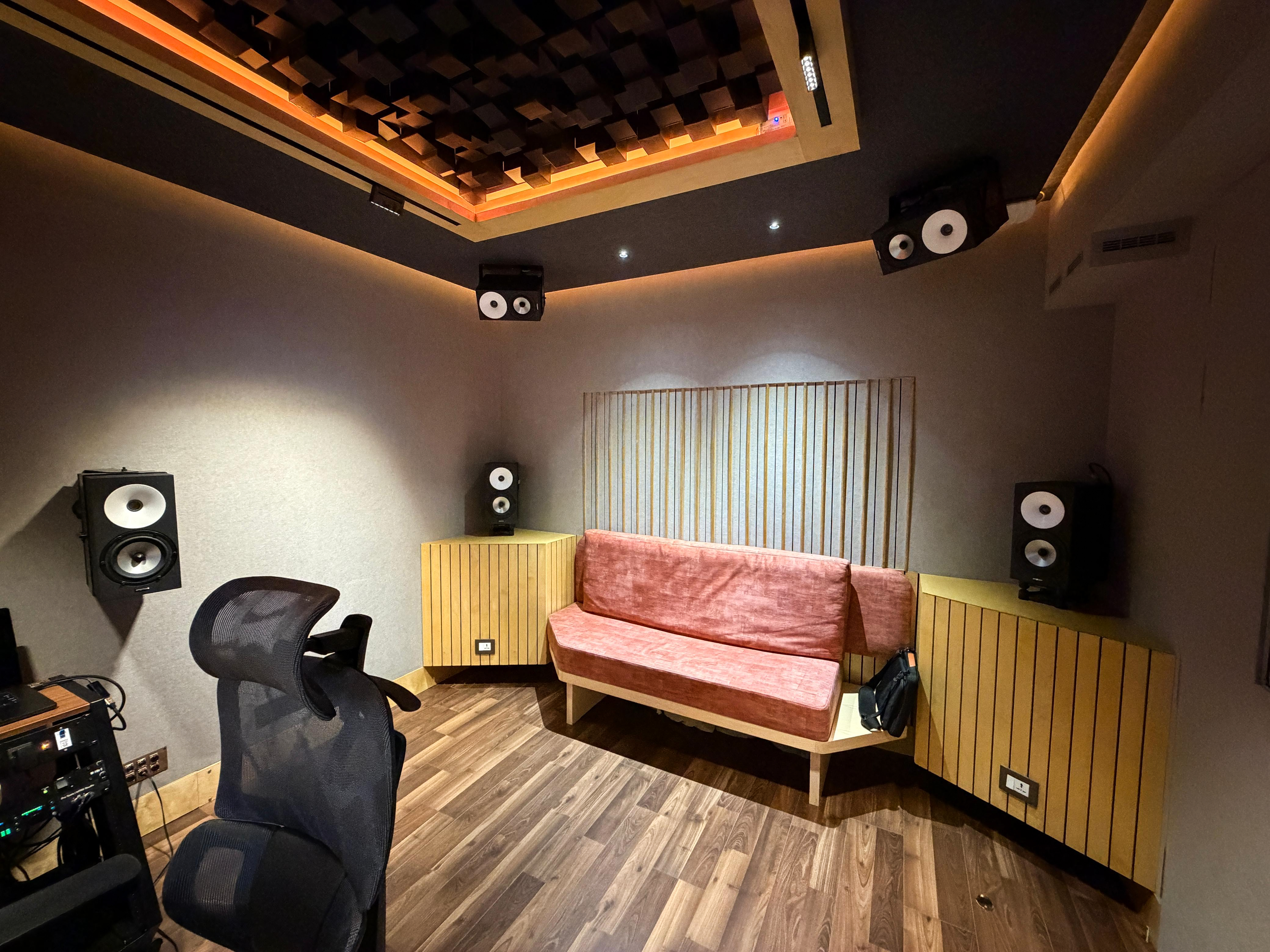
I have my Amphion Two18s as my LR, and my remaining ear-level monitors are the One18s. My ceiling monitors are the One15s, and I have the FlexBase25 working both as a stereo expansion when using in 2.0, as well as a dedicated LFE channel when using in surround. In terms of rack equipment, I have the Amphion Amp400.12 to power all the monitors, the FlexAmp1200 to power the FlexBase25, and my main interface is the Avid MTRX Studio. I also use a McDSP APB16 for any outboard processing, phenomenal piece of equipment, that.
Hopefully, my work will be a healthy mix of all formats. I work extensively in background score mixes, so lots of 7.1.4 mixing, and of course stereo mixing and mastering of songs will always be a staple for me. Focusing on my own music in my free time, and venturing into something new like music and immersive sound for video games is also something I’ve always wanted to do. I’m excited for what comes next.
For more information on: Pradvay Shivasankar (IMDb)
For more information on: Ansata (India)
For more information on: Amphion Immersive Audio